Showing posts with label Ewa Plain. Show all posts

Saturday, January 10, 2015

Oahu's Ewa Plain Karst Sinkholes And Caves Yield Extinct Bird Fossils

Oahu's Ewa Plain Karst Sinkholes And Caves Yield Extinct Bird Fossils 

By Jan TenBruggencate, Advertiser Science Writer  August 7, 2007 

http://the.honoluluadvertiser.com/article/2007/Aug/07/ln/hawaii708070352.html

SINKHOLE BIRDS THAT ARE EXTINCT

Extinct species of birds from sinkholes on the 'Ewa Plain:

Pterodroma jugabilis, a medium-sized petrel
Thambetochen xanion, a large flightless species of waterfowl (moa nalo)
Branta (uncertain species), a weak-flying goose, closely related to the nene
Porzana ziegleri, a small flightless rail
Porzana ralphorum, a large flightless rail
Circus dossenus, a small harrier, apparently adapted to feed on forest birds
Grallistrix geleches, a long-legged, bird-eating owl
Corvus impluviatus, a raven-sized crow with a deep, arched bill
Corvus viriosus, a raven-sized crow with a long, straight bill
Myadestes oahuensis, the O'ahu thrush
Moho apicalis, the O'ahu 'o'o (a honeyeater)
Chaetoptila (related to) angustipluma, a large honeyeater
Telespiza persecutrix, a small finch similar to the Laysan and Nihoa finches
Chloridops wahi, a grosbeak finch similar to the extinct Kona finch of the Big Island.
Chloridops regiskongi, a grosbeak finch with a really large bill, nicknamed King Kong finch.
Rhodacanthis litotes, similar to the extinct koa-finches of the Big Island.
Xestospiza fastigialis, a finch with a conical bill that was once common on O'ahu, Moloka'i and Maui.
Hemignathus upupirostris, an 'akialoa (Hawaiian honeycreeper with a long, thin, decurved bill)
Aidemedia chascax, a Hawaiian honeycreeper with a long, straight bill
Aidemedia zanclops, a Hawaiian honeycreeper with a sickle-shaped bill
Ciridops (uncertain species), a short-billed, strong-legged Hawaiian honeycreeper of a type previously known only from the Big Island.

SINKHOLE BIRDS STILL THRIVING

Sinkhole birds that are not extinct:

Pterodroma sandwichensis, the Hawaiian petrel; not previously known from O'ahu but bones are abundant in the sinkholes, showing that the region once had a major colony.
Haliaeetus (related to) albicilla, the white-tailed sea eagle. These eagles were either resident in the Islands or were regular visitors in the past. (A sea eagle was spotted on Kaua'i and possibly on O'ahu late last year and earlier this year.)
Telespiza cantans, the Laysan finch, known historically only from Laysan Island.
Loxioides bailleui, the Palila, known historically only from high-elevation Big Island mamane-naio forest.

Source: Helen James, Smithsonian Institution


Oahu sinkholes yield extinct birds

The baking sun and thorny kiawe trees of Kapolei hide dense caches of history, relics from a time when the 'Ewa Plain was a dense forest alive with strange birds now long extinct.


In those years, before the arrival of humans, the amazing moa nalo lumbered through the trees. It was a 3-foot-tall, flightless gooselike duck — the largest of the Native Hawaiian birds. Flightless rails and geese waddled around with it. Overhead flew a sea eagle, owls, crows, a hawk and bats. Finches and other perching birds flitted among the trees.

Most of these birds have been extinct for hundreds of years.

But proof of their existence lies in the bottom of limestone "sinkholes" where they sometimes were trapped and died, leaving their bones and beaks behind. The shells of now-extinct tree snails, and the pollen from the plants that once forested this area are found in sediments with the bones.

The sinkholes are vertical caves in an ancient reef that grew during a period 120,000 years ago when sea levels were much higher. There once were thousands of sinkholes across the 'Ewa Plain — time traps that preserved evidence from Hawai'i's prehistory.

Most have already been filled or covered by development.

Kapolei Property Development, which is proposing a 350-acre light industrial park at Kapolei, plans to preserve a six-acre parcel of undisturbed land that contains several of the sinkholes.

A chain-link fence, stained pale brown with the coral dust of the region, protects the acreage.
"This area hasn't been touched," said Steve Kelly, manager of development for Kapolei Property Development. "It was fenced in the early 1990s by the Estate of James Campbell, and we plan to put a new fence around it. We will be looking to pass on the property to some appropriate entity."
Scientists and community leaders cheer the firm's decision.

"This is a community resource, a place where people can come and learn about the past," said Ati Jeffers-Fabro, an environmental educator who has brought kids to the sinkholes to learn natural history.

"This is all we have left of a unique geological and biological setting in these Islands," said Helen James, a fossil bird expert at the Smithsonian Institution, who with her former husband, Storrs Olson, has taken the lead in identifying the ancient bones and beaks. "For future understanding and research of the Islands' natural history, we should preserve this."

The Conservation Council for Hawai'i is spearheading the effort to ensure protection for the sinkholes. Council executive director Marjorie Ziegler said the organization would like the six-acre plot to be transferred to the Department of Land and Natural Resources, perhaps designated as a state Natural Area Reserve. But if not that organization, some other caretaker should be established, she said.

Key goals are protection, scientific research, public education and the possible reforestation of the area with some of the native plants that the pollen record proves once lived here, Ziegler said.

The first person to find bird bones in sinkholes here was Jennie Peterson, now the environmental education program manager with the Hawai'i Nature Center. During the 1970s, she was an archaeologist with Bishop Museum, studying the area for an environmental impact statement on the then-proposed Deep Draft Harbor.

"I was digging in a large sinkhole when I found bones. They were so big that I thought they were mammal bones, but I knew they couldn't be because they were too light," she said.

'VANISHED FOWL'

No animal known to have lived in Hawai'i could have produced those bones, so she took them to Bishop Museum zoologist Alan Ziegler, Marjorie Ziegler's dad. He recognized they were the same class as extinct birds whose bones had been found in sand dune deposits on Moloka'i, and consulted with Olson, the Smithsonian Institution fossil bird expert, who happened to be conducting research on Maui.

It was a huge bird like nothing alive in the world today.

They called the group "vanished fowl," or moa nalo in Hawaiian. There are examples in the fossil record on all the major islands. The O'ahu moa nalo was given the scientific name of Thambetochen xanion.

A grazing animal, it looked most like a huge goose, but appeared to be most closely related to the dabbling ducks, said James, with the Smithsonian. The moa nalo had lost the ability to fly, and its flight muscles — robust in ducks and geese — were just thin straps across its chest, she said.

Further digging in sinkholes — some of them dry, and some with pools so deep that scuba gear was needed — yielded the bones of dozens of species of flightless birds, land birds, sea birds and raptors. The most common bones came from the ua'u, or Hawaiian dark-rumped petrel. This seabird has never been reported from O'ahu in historic times, but the fossil evidence shows there was an immense number of the birds here at one time.

"There must have been a major colony here. The whole 'Ewa Plain was just covered in them," James said.

When a team of visiting scientists, students and community members explored the six-acre Kapolei site last month, in a few minutes, one collected a handful of bones lying in plain view on the floor of a sinkhole. The collection included wing bones from ua'u and an extinct crow, skulls of ua'u and the beak of a very large, raven-sized extinct crow. The extinct crow has been named Corvus impluviatus.

Today, people think of the arid Kapolei area as former desert, but in pre-human times, it was forested.'

Researchers have found shells from extinct tree snails, and the pollen from the kinds of vegetation that probably once populated 'Ewa, including pritchardia palms, an acacia that was probably koai'a, and a critically endangered legume called kanaloa.

SURVIVAL PRECARIOUS

Once common, the kanaloa was found growing on Kaho'olawe, but its survival is exceedingly precarious, with just one plant in the wild and one in captivity. There has been no success in getting it to reproduce.

Preliminary dating of the sinkhole material suggests that most of the bird species were in the region for thousands of years, and most disappeared from the area in the years after human contact with the Islands. It is not yet clear what the direct cause was — perhaps humans directly feeding on birds, fire or other kinds of habitat disturbance, human-brought rats that could have both eaten vegetation and bird eggs, or something else.

Michigan State University zoology professor Peggy Ostrom is conducting studies to help answer some of the questions. She said she and her students will attempt to extract proteins from fossils for radio-carbon dating, and to analyze material in the bones to gain information about what the birds ate.
She and James also hope to find clues about the fate of the sinkhole birds.

"I'd be careful about making assumptions. It could have been a number of things," Ostrom said.
There is very little left of the prehistoric life of this region. Almost all the vegetation is modern weeds and hardy introduced trees like kiawe and banyan.

But deep in at least one of the wet sinkholes, in a tiny pool of brackish water, by the illumination from a flashlight, you can see tiny flickers of movement. They are the native anchialine shrimp — living in darkness and among the last survivors of the time when this region was alive with forms of life no living human has ever seen.

Oahu's Ewa Plain Karst Sinkholes And Caves Yield Extinct Bird Fossils

 http://ewa-hawaii-karst.blogspot.com/2015/01/ewa-plain-karst-sinkholes-and.html

US Fish & Wildlife Demonstrates How Ewa Plain Karst Can Be Restored

 http://ewa-hawaii-karst.blogspot.com/2014/12/us-fish-wildlife-ewa-preserve.html

Saturday, December 27, 2014

Ewa Plain Karst: A Precise Cut Into The Karst For An Amazing View Back In Time

Ewa Plain Karst: A Precise Cut Into The Karst For An Amazing View Back In Time

by John Bond,  Kanehili Hui


A precise long cut into the karst near Barbers Point light house reveals pre-history

A drainage canal on the Ewa Plain tells an interesting story about pre-history 
and early native Hawaiian karst culture. This area is all ancient limestone reef.
It was at one time many thousands of years ago an ocean reef teeming with
fish and many types of coral. When the sea level dropped, acidic rain water
began dissolving the calcium carbonate forming sinkholes and caves.


When this cutting work was done is not known at this time, but possibly 1960's. 


A quarry cutting saw was likely used - an amazing slice into the ancient Ewa reef


A smooth water "pipe" feature like this indicates a long period of acidic rain water flow


Several types of karst sinkhole and cave features can be seen in one place


More variations in how rain water and time eroded through the reef after sea level fell


The tunnels and channels through the ancient reef vary greatly based on coral species 


This actually looks like it could have been a native habitation and possible burial site


This was likely formed over centuries by an upland stream of water passing through


Who knows - this could have contained ancient bird bones and plant seeds long extinct


A channel like this is just a microcosm of larger channels much further down in the karst 


A great cross section of a sinkhole which could lead down to a sea water cave chamber


A quarry saw was likely used to cut this drainage canal like a piece of cake.

Photos By John Bond,  Kanehili Cultural Hui

Honolulu Cave Adventure: Punynari Explores Moiliili (Honolulu, Hawaii) Karst 

Fantastic Must See Oahu Karst Cave Videos And Photos 

Bio Diversity: The Moiliili Karst Formation

Mōʻiliʻili Karst Water Cave


Hiking Hawaii: Moiliili (Honolulu, Hawaii) Karst Cave


Video and Links: Mo'ili'ili Underground Caverns Video 


Karst Cave Hiking Adventure: Moili'ili Karst Exploration 


Friday, December 26, 2014

Opae Ula - The Native Hawaiian Fresh Water Karst Shrimp That Lives (Still Barely) Under The Ewa Plain

Opae Ula - The Native Hawaiian Fresh Water Karst Shrimp That Lives (Still Barely) Under The Ewa Plain

by John Bond  Kanehili Cultural Hui

Opae`ula live under the Ewa Plain but their habitats are under great threat from developers filling karst reef sinkholes and caves with dirt and concrete.


*******************************************************************

Manoa School studied the opae`ula 

Opae`ula are tiny shrimp that are usually red but can sometimes be pink or white. They are only found on the islands of Hawaii. Their scientific name is Halocaridina Rubra. That's a mouth full so we call them by their Hawaiian name, opae`ula. In the Hawaiian language opae means shrimp and ula means red. While these red shrimp are not endangered, their habitats are impacted by people. These animals can die from many things people do. The 4th and 5th grade classes of Manoa School studied the opae`ula and made mini habitats during the summer of 2012. Our mini habitats are now with us at home and we will be keeping logs of how they are doing. Please check out our site to learn more! 

http://opaeula.weebly.com/

*****************************************************************************

Coastal restoration and water quality monitoring at Kalaeloa

On the second day of the session, we traveled to Kalaeloa, which is very close to Kapolei High School. There, we met with Lorena Wada (Aunty Tap) of the U.S. Fish and Wildlife Service.  She is a wildlife biologist who does a lot of different type of work to save rare and endangered species.

This area is a wildlife refuge and from first glance, is not much to look at, but upon closer inspection, you can see why this is a special area. Once covered with tall, invasive trees, this area now is being restored with native Hawaiian coastal plants. And the anchialine ponds are now visible, which gives us a glimpse into the mysterious world underground.

http://hawaiigreencollarinstitute.blogspot.com/2011/12/coastal-restoration-and-water-quality.html

**************************************************************************

A Visit To An Oahu Coral Habitat

Although the "pond" opening is small compared to the Big Island anchialine ponds,  it is clear that several feet below the surface, that there is an interconnected labyrinth of passageways that allow the opae'ula to travel long distances through Oahu coral in much the same way as the lava tubes and cracks allow travel through porous Big Island lava.

The opae'ula of Oahu are distinctive and have bands.  Some are pale throughout. A few are pale with red heads, others have various amounts of reddish and pale combinations.  The photo is of the Waianae strain being maintained as part of the Fuku-Bonsai Micro-Lobster exhibit.

http://www.fukubonsai.com/M-L2b4.html

***************************************************************************


Oahu's Ewa Plain Karst Sinkholes And Caves Yield Extinct Bird Fossils

US Fish Wildlife Demonstrates How 

Ewa Plain Karst Can Be Restored

Honolulu Cave Adventure: Punynari Explores Moiliili (Honolulu, Hawaii) Karst 

Fantastic Must See Oahu Karst Cave Videos And Photos 

Bio Diversity: The Moiliili Karst Formation

Mōʻiliʻili Karst Water Cave


Hiking Hawaii: Moiliili (Honolulu, Hawaii) Karst Cave


Video and Links: Mo'ili'ili Underground Caverns Video 


Karst Cave Hiking Adventure: Moili'ili Karst Exploration 


Thursday, December 25, 2014

The Ewa Plain Karst is the largest of several karsts on the island of Oahu

The Ewa Plain Karst is the largest of several karsts on the island of Oahu

Yet one of the least known! (The reason: Ewa developers oppose studies)


Anne Wiley, Michigan State University doctoral student, left, and Andreanna Welch, doctoral student at the University of Maryland, look around in an Ewa sinkhole 

Despite its impressive extent and archaeological and palaeontological values, the Ewa Karst is almost entirely unknown to karstographers and speleologists. 

(Pre-printed from The Cave Conservationist - February 1998)


The Ewa Karst is the largest of several karsts on the well-populated island of Oahu, yet one of the least known (Halliday, 1994). Its exact dimensions are uncertain because geological maps show considerable upslope areas as alluvium and some shore areas as sand. 

However it clearly covers at least 50 km2 in the southwest corner of the island of Oahu (Figure 1). It is a semitropical littoral karst formed on porous, permeable algal and coralline reef deposits formed during at least three high stands of sea level (Figure 2), perhaps with a higher content of sand-sized clasts of foraminifera than contemporaneous Caribbean deposits (Chester Lao, written communication, 1997). 

Some artesian flow is said to be present, confined by clay layers (Chester Lao, oral communication, 1997). The U.S. Geological Survey Ewa Quadrangle shows numerous sinking streams and closed depressions within the Karst. Some of the former are artificial: the result of past water diversion for farming, ranching and domestic use. Some of the depressions are man made also. Most of the land surface of the karst has been subjected to more than a century of extensive reworking by man.

In 1955, the late Harold S. Palmer (Professor of Geology at the University of Hawaii) told me he had seen a meter-long stalactite said to have come from a cave in the Ewa Karst (Halliday, 1955, 1958). Extensive bibliographic and some field investigations have yielded no information about this cave and it is not known if it still exists. In 1970, Macdonald and Ahhott mentioned the presence of small caves in calcarenite and aeolianite in this and several other karstic localities (Macdonald and Abbott, 1970) but did not amplify. 

Sinkholes of Kalaeloa

by | Mar 29, 2009
http://hawaiianforest.com/wp/sinkholes-of-kalaeloa/

I explored the kiawe forests of Kalaeloa — the former Barber’s Point Naval Air Station — to investigate the innumerable sinkholes in the limestone that were once home to rare native land snails.

Limestone, the remnants of coral reefs when the sea level was higher, underlies the greater part of Kalaeloa and the Ewa Plain.   Located in the rain shadow of the Koolau and Waianae Mountains, Kalaeloa is located in the driest corner of Oahu, receiving less than 20 inches of rain per year.  While the surface of the land is dry and hot for most of the year, just below the surface lies ground water which seeps from the mountains under the Ewa Plain.

Beacons from the Ewa Plains

September 22, 2012

http://studiamirabilium.com/2012/09/22/beacons-from-the-ewa-plains/

Not too many people think of the natural wonders of Hawai’i when they see the Ewa Plains. The present is dominant by such thoughts as commute times, median home prices, proximity to good schools. People do think of its rich past: many extinct native birds have been found fossilized in the uplifted limestone plains. But it’s these wonderful plants, an akoko here, a rare naio there, that offer beacons of hope for a great future.

Honolulu Cave Adventure: Punynari Explores Moiliili (Honolulu, Hawaii) Karst 

Fantastic Must See Oahu Karst Cave Videos And Photos 

Bio Diversity: The Moiliili Karst Formation

Mōʻiliʻili Karst Water Cave


Hiking Hawaii: Moiliili (Honolulu, Hawaii) Karst Cave


Video and Links: Mo'ili'ili Underground Caverns Video 


Karst Cave Hiking Adventure: Moili'ili Karst Exploration 


Wednesday, December 24, 2014

US Fish & Wildlife Demonstrates How Ewa Plain Karst Can Be Restored

US Fish Wildlife Demonstrates How Ewa Plain Karst Can Be Restored


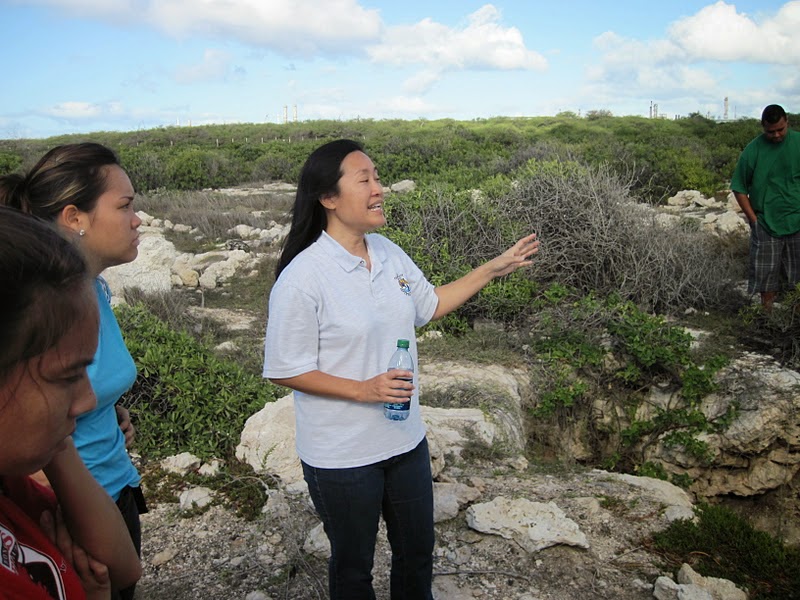
U.S. Fish Wildlife Preserve Manager Explains Karst Sinkhole Restoration To
Kanehili Cultural Hui Members Mike Lee And John Bond 

 Rare Fossil Discovery On Oahu's Ewa Plain 

https://www.youtube.com/watch?v=Pdq1BQmYbh0


Coastal restoration and water quality monitoring at Kalaeloa

On the second day of the session, we traveled to Kalaeloa, which is very close to Kapolei High School. There, we met with Lorena Wada (Aunty Tap) of the U.S. Fish and Wildlife Service.  She is a wildlife biologist who does a lot of different type of work to save rare and endangered species.

This area is a wildlife refuge and from first glance, is not much to look at, but upon closer inspection, you can see why this is a special area. Once covered with tall, invasive trees, this area now is being restored with native Hawaiian coastal plants. And the anchialine ponds are now visible, which gives us a glimpse into the mysterious world underground.


Lorena Wada (Aunty Tap) of the U.S. Fish and Wildlife Service


Honolulu Cave Adventure: Punynari Explores Moiliili (Honolulu, Hawaii) Karst 

Fantastic Must See Oahu Karst Cave Videos And Photos 

Bio Diversity: The Moiliili Karst Formation

Mōʻiliʻili Karst Water Cave


Hiking Hawaii: Moiliili (Honolulu, Hawaii) Karst Cave


Video and Links: Mo'ili'ili Underground Caverns Video 


Karst Cave Hiking Adventure: Moili'ili Karst Exploration 


Monday, December 22, 2014

Evidence Of Large Karst Sinkholes In Ewa Gentry Community Properties

Evidence Of Large Karst Sinkholes In Ewa Gentry Community Properties - Updated to 2021

Ewa Cultural History Historian  John M. Bond

A fascinating look at some of the major sinkholes in the Ewa area.
The entire Ewa Plain is approximately 25 square miles of sinkholes and caves,
some very big and some very small. 

The Ewa Gentry area was built 
over numerous huge karst sinkhole caves as early cultural oral history 
will tell you, and also visible on old USGS maps. One of the really big ones still 
exists and has never been filled in.


Holomua Elementary School which is directly north of this big
sinkhole is known for being haunted with mysterious sounds and
noises. This is likely due to the large underground karst cave
channels that carry rainwater from the mountains and dumps into
the shoreline. 

This area has one of the largest subsurface waterways
that emptied into the Puuloa reef area. Puuloa was known for
large caves, including royal burial caves, and the massive rain
water discharge feed the copious amounts of limu that once
existed there. 

Limu feeds the ecosystem of the fisheries however
much of this has since been destroyed by developments.

Image Below: Holomua Elementary School seen mauka (north) of this 
huge Ewa Plain sinkhole cave site.


It has been used as a flood drainage basin- with the water traveling out through 
the porous karst to the Ewa Puuloa shoreline near the entrance to Pearl Harbor.


This particular development in the Honolulu Star Advertiser story of October 2021
 is directly south of a huge Karst sinkhole cave site as was documented in
this Kanehili Ewa Karst blog in 2014 and now updated.

One of the largest still existing huge deep sinkhole caves is directly adjacent 
(north) to this Gentry development project. I was told many years ago that 
this was left undeveloped because it drains water from the nearby developments. 

However many others like it were filled in and over time rains cause the coral fill to 
subside and wash away exposing pipes underground to corrosion and breaking 
under stress which causes water leaks and eventually breaks. 

This happens all over Oahu's south shore because it is all ancient
coral reef and the subsurface water erosion is continuous 
causing water and sewer pipes to corrode and break, usually flooding streets.


The karst in this area is especially dense with lots of evidence of ancient sea creatures


This site along Kapolei Parkway was later filled up and turned into Geiger 
park as they probably didn't want to put homes over it.


This site exhibits classic groundwater near the surface as it is near the 
Kalo'i waterway that empties by Hau Bush Ewa shoreline park.


Ewa Haseko Corp Digs Big Giant Hole In The Ewa Karst 

And Then Fills It Back Up!


Barbers Point - Kalaeloa - Ewa Beach, The Major Karst Sinkhole Ponds And Reef Blue Holes

https://ewa-hawaii-karst.blogspot.com/2015/08/barbers-point-kalaeloa-sinkholes.html

Fantastic Must See Oahu Karst Cave Videos And Photos 

Bio Diversity: The Moiliili Karst Formation

Mōʻiliʻili Karst Water Cave


Hiking Hawaii: Moiliili (Honolulu, Hawaii) Karst Cave


Video and Links: Mo'ili'ili Underground Caverns Video 


Karst Cave Hiking Adventure: Moili'ili Karst Exploration 


Wednesday, June 19, 2013

Fantastic Must See Oahu Karst Cave Videos And Photos


Honolulu's Secret Karst Caves

Oahu Karst Cave Videos And Photos


Karst Caves and Underground Karst waterways exist throughout Honolulu- the Southern Oahu shoreline, all Pearl Harbor (Aiea, Navy, Hickam, Pearl City, Waipahu, etc.), ALL of the Ewa Plain, Waianae shoreline, etc.

There are also Karst Caves and water systems along the North Shore and Windward Oahu. A very large Karst Cave in Laie has yielded large amounts of calcite in the form of stalactite-stalagmites and karst Cave calcite has been commonly found on beaches- it is a sparkly, milky white mineral.

Legally, no one should be removing these minerals from existing Karst caves!

Visiting the fairly well documented Moiliili Karst is potentially dangerous and not recommended - however scientific exploration and documentation is highly encouraged.
There was a major Karst cave collapse in Moiliili in the 1930's.
Are we just going to wait for the next one to happen?

City and State government has been nearly completely ignoring future Karst collapse, sea level rise, Ala Wai canal pollution (which is only a fraction of the shoreline pollution going on and not mitigated.) ground water inundation and other very important water issues- despite
existing State Laws, the State Constitution, Public Trust, federal laws and supposed Shoreline Management.

Scientific studies and local shorelines around the Hawaiian Islands are becoming ecological dead zones and more and more fresh water is pumped out or badly polluted and dumped into the ocean.
There is a direct connection between fresh, unpolluted water flowing into the ocean and the ecological health of shoreline and the creatures that live there. Like the mass die off of bees, these small shore sea creatures and algae actually play an important role in our island
ecological health and sustainability. We are headed toward lifeless desert shorelines right now in Hawaii.

Our City and State government officials come pretty close to criminal negligence by not looking out for the health and welfare of its citizens and CLEAN WATER should be number one on the government agenda as we are living on an Island and everything will die without it.
We need to look to the Konohiki system of ecological management of our shorelines as the template for our survival.

Pouring concrete into Karst water caves and fresh water water channels is a sign of a very sick and corrupt government and ultimately will not stop what water intends to do.
It's also a violation of State laws, the Hawaii State Constitution and the Federal Clean Water Act, but the Hawaii government allows this all the time due to contractor-developer pay-offs.
Properly mitigated, sustainable development is what is needed, not the fast bucks and leave town tomorrow mentality that controls our Hawaii government now.

Kanehili Cultural Hui

**************************************************************************

 The Moiliili Karst Formation

http://explorebiodiversity.com/Hawaii/hikes/Moiliili/cavemap.html

http://explorebiodiversity.com/Hawaii/hikes/Moiliili/caveorganisms.html

**************************************************************************
Moili'ili Karst Cave Exploration

http://www.alohafrom808.com/2012/06/moiliili-karst-cave-exploration-june-2012/

***************************************************************************

Moili'ili Karst Exploration

http://notsogreathikingblog.blogspot.com/2012/06/moiliili-karst-exploration.html

http://www.youtube.com/watch?feature=player_embedded&v=RrGTMYk5cXI

****************************************************************************

Moiliili Karst

http://easyhikerhawaii.blogspot.com/2012/07/moiliili-karst.html

****************************************************************************

Mōʻiliʻili Karst (Mōʻiliʻili Water Cave)

http://totakeresponsibility.blogspot.com/2012/12/moiliili-karst-moiliili-water-cave.html

*****************************************************************************